Project Summary:
1. Sustainable MCCA Production from Organic Waste Using AnDMBR
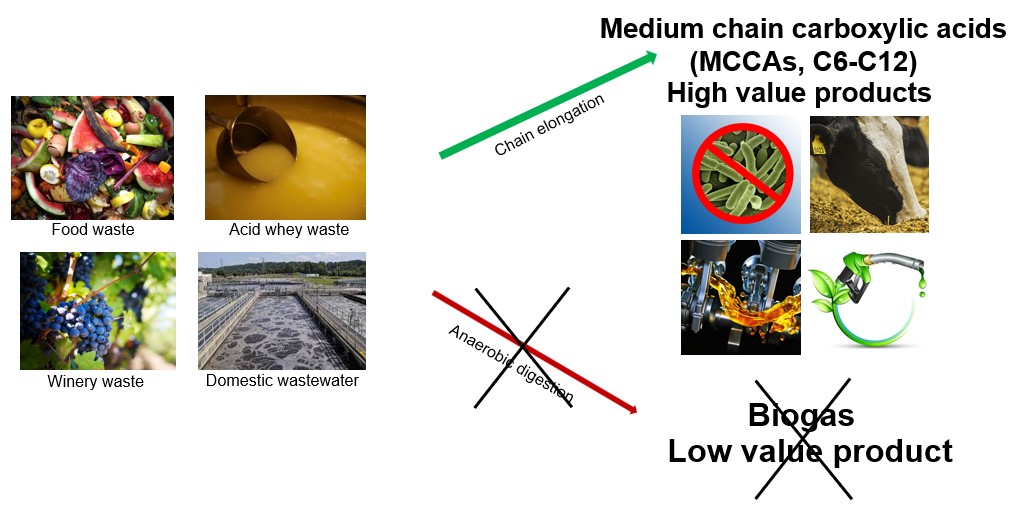
In this project, we aim to develop new technologies to recover valuable products—such as medium-chain carboxylic acids (MCCAs)—from organic waste streams. MCCAs are straight-chain monocarboxylic acids with chain lengths ranging from six to twelve carbon atoms. They can be directly used as antimicrobials, plant growth promoters, and food additives, and can also be processed into pharmaceuticals, fragrances, lubricants, rubbers, dyes, and liquid biofuels.
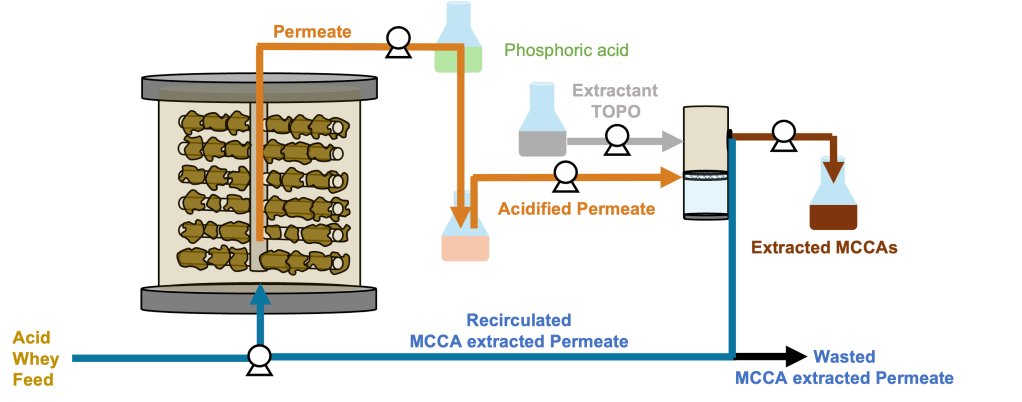
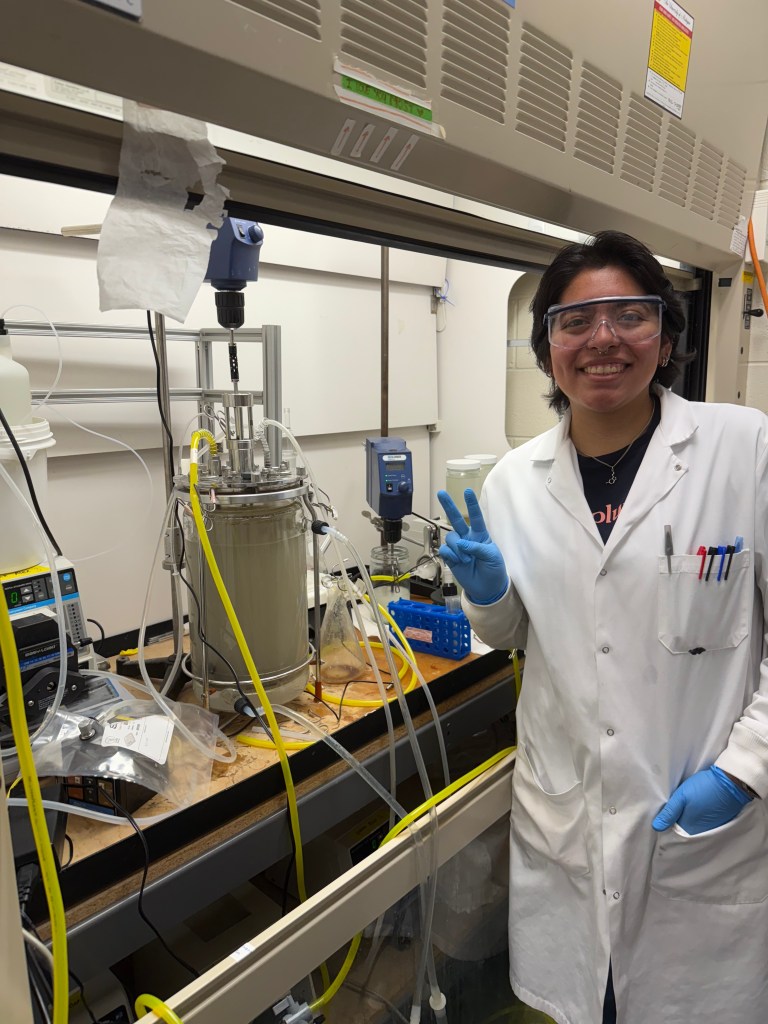
Current methods for MCCA production rely on unsustainable feedstocks such as plant oils, animal fats, and petroleum-derived compounds. In contrast, producing MCCAs from renewable sources like organic waste and wastewater offers a more sustainable alternative. Using an Anaerobic Dynamic Membrane Bioreactor (AnDMBR), we achieve efficient lactate-based chain elongation while maintaining high microbial biomass retention. This system enables cost-effective MCCA production and valorization of dairy waste, advancing circular bioeconomy goals.
MCCA production from organic waste is primarily driven by chain elongation using mixed microbial communities. Ongoing research focuses on improving this process by: i) Enhancing MCCA production efficiency and selectivity, ii) Gaining deeper insights into microbial community composition and functional structure, iii) Developing advanced technologies for integrated MCCA production and resource recovery.
2. Addressing MCCA Toxicity and Enhancing Recovery with CLEANS
The accumulation of medium-chain carboxylic acids (MCCAs) can inhibit microbial activity and reduce the efficiency of chain elongation. At high concentrations, undissociated MCCAs diffuse across cell membranes, disrupting membrane integrity, acidifying the cytoplasm, and imposing metabolic stress by increasing the energy required for pH homeostasis. These inhibitory effects can slow microbial growth, destabilize community structure, and suppress key metabolic functions.
Our research investigates how MCCA toxicity impacts microbial community composition, metabolic activity, and gene expression. To overcome these challenges and improve MCCA recovery, we employ a combination of strategies:
- In situ extraction using CLEANS — a membrane-based continuous liquid–liquid extraction system that removes MCCAs during fermentation, reduces product inhibition, and supports microbial stability.
- Engineering synthetic microbial communities — assembling defined consortia with complementary metabolic functions and enhanced MCCA tolerance to improve system resilience and chain elongation performance.
- Process optimization and microbial adaptation — including pH control to minimize undissociated acid accumulation, and selective enrichment or evolution of MCCA-tolerant microbial populations.
Group members:
Xinran Zhang: PhD Student
Daniela Martinez: MSE Student
Past members:
Dr. Dianna Kitt – PostDoc at Johns Hopkins University
Dr. Shilve Shrestha – Assistant Professor at Johns Hopkins University
Hang Song – PhD student at University of Michigan
Siqi Xue

Collaborators: Dr. Shilva Shrestha (Johns Hopkins University)
Relevant publications and presentations:
S. Shrestha, S. Xue, D. Kitt, H. Song, C. Truyers, M. Muermans, I. Smets, and L. Raskin, “Anaerobic dynamic membrane bioreactor development to facilitate organic waste conversion to medium-chain carboxylic acids and their downstream recovery,” Environ. Sci. Technol. Eng., vol. 2, no. 2, pp. 169–180, 2022, doi: 10.1021/acsestengg.1c00273.
D. Kitt, “Anaerobic dynamic membrane bioreactors (AnDMBRs) to intensify and expand anaerobic digestion applications,” presented at the AD18 IWA, Istanbul, Turkey, Jun. 2, 2024.
X. Zhang, D. Kitt, H. Song, S. Shrestha, and L. Raskin, “Using chain elongation to produce medium chain carboxylic acids from acid whey,” presented at the 2024 Midwest Microbiome Symposium, University of Michigan, Ann Arbor, MI, USA, May 15, 2024.
D. Kitt, Advancing anaerobic biotechnologies for medium chain carboxylic acid production from organic waste, Ph.D. dissertation, Dept. of Civil and Environmental Engineering, Univ. of Michigan, Ann Arbor, MI, 2025.
 Raskin Research Group